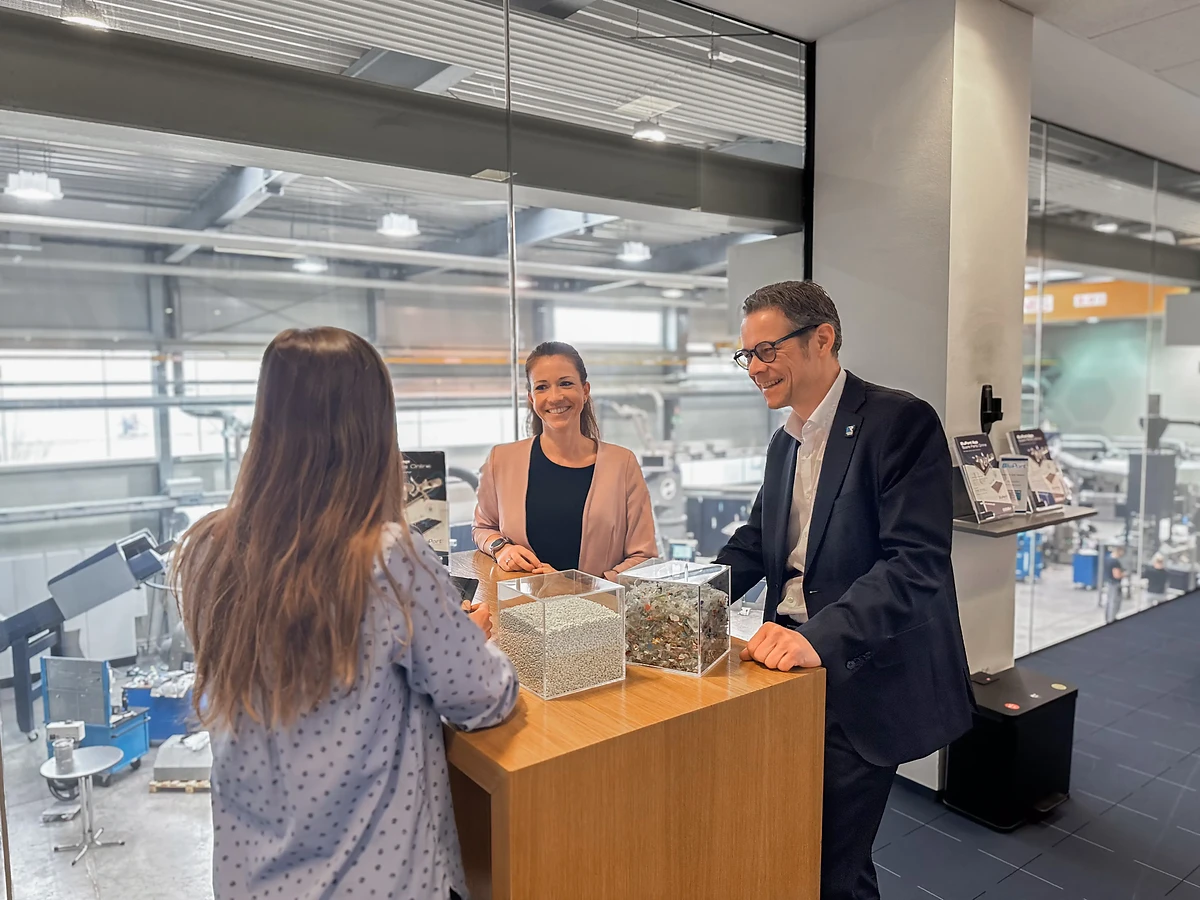
Digitalisation and AI are becoming indispensable tools for recycling companies to keep their processes stable and their production efficient. We spoke with Markus Huber-Lindinger, Managing Director at EREMA, and Yvonne Kappacher-Winter, R&D Engineer at EREMA, about current challenges in plastics recycling and how EREMA’s digital ecosystem helps customers operate more efficiently and reliably.
What are the biggest challenges recyclers face today where digitalization can make a real difference?
Markus Huber-Lindinger: The complexity of modern recycling processes is increasing. Many of our customers must consistently deliver recyclate qualities that meet strict specifications, while at the same time coping with highly fluctuating input material. On top of that, skilled labour is scarce. Not every production shift has specialists available who can monitor the process and react to changes immediately.
This is where digital solutions come in. They create transparency along the entire process chain and provide operators with targeted decision support. By analysing process data, correlations become visible that would otherwise remain hidden in daily operation. With our tools for automated quality and process monitoring as well as predictive maintenance based on real-time machine data, our customers gain both stability and productivity.
What is driving the integration of digitalization and AI in the plastics recycling industry?
Markus Huber-Lindinger: The strongest driver is the increasing demand for consistent recyclate quality combined with cost‑efficient production. Our customers need to meet rising regulatory requirements as well as the expectations of global brands aiming for higher recycled content. Digitalisation is the key to compensating for material fluctuations, improving process stability and reducing energy and resource consumption. At EREMA, we see two parallel developments:
First, we continuously digitalise our own production processes. Second, we advance the intelligence of our machines. Availability and quality assurance are becoming central to our innovation work.
In doing so, we keep an eye on the entire value chain. Together with Lindner Washtech, we are developing integrated, data‑driven process solutions that enable automatic interventions and condition‑based maintenance. This will make recycling more transparent and more efficient along the overall process – from bale to pellet.
EREMA offers a broad range of digital tools. Which are currently creating the most value for customers?
Markus Huber-Lindinger: Three areas stand out:
Across all solutions, our focus is on practical benefits: supporting operators in their work and making processes more robust.
PredictOn has become a core part of EREMA’s digital ecosystem. Could you please explain what it does and how it supports operators?
Yvonne Kappacher-Winter: PredictOn is an intelligent assistance system that accompanies the recycling process in real time. It continuously monitors and analyses relevant operating status data to identify patterns and detect anomalies or deviations from normal operations. Detecting wear on key components at an early stage minimises the risk of unscheduled downtime in plastics recycling.
The aim is clearly defined: maximise machine availability and ensure process stability. PredictOn shows operators exactly when action is required, and, in contrast to routine preventive maintenance, is only performed if really necessary. Thus, it prevents unnecessary maintenance while avoiding costly, unexpected failures. In addition, it supports teams in carrying out unscheduled maintenance activities in a targeted and well-coordinated manner.
Two modules are available at the moment:
Developing predictive maintenance tools for such diverse applications sounds challenging. What were the biggest hurdles?
Yvonne Kappacher-Winter: It is indeed a complex task. Our recycling systems process a wide variety of materials, and machines differ in size and configuration. That makes data analysis demanding because models must work reliably in all environments.
Another challenge was coordinating the internal collaboration. Many departments were involved – from R&D and software development to service specialists. But this teamwork is also one of the most rewarding parts of developing digital solutions. It allowed us to build PredictOn from the ground up as a customer‑centred system.
AI is becoming increasingly important in industry. How is EREMA using AI today and what is still to come?
Markus Huber-Lindinger: AI is a powerful tool in our digital toolbox. We already use AI‑based algorithms for deep data analysis in PredictOn:Drive, which monitors the main drive trains. The system enhances pattern recognition and fault diagnostics.
The next big step will be enabling AI applications to run directly on standard or retrofitted PLC-based machine control systems. This requires clever data utilisation because, unlike ChatGPT which draws from decades of internet content, industrial applications must work with smaller, specialised datasets. The question is: how do we make AI powerful even when the database is limited?
Long‑term, the development clearly moves toward self‑optimising machines.
Digital solutions must work in daily practice. What have you learned from customer behaviour?
Yvonne Kappacher-Winter: One important lesson: simplicity wins. For example, we once introduced smart glasses for commissioning support. In practice, hardly any customers used them. They preferred their smartphones to share photos and videos with service teams and hold live calls directly at the machine. This is a good reminder that digital innovation must match real‑world habits. That said, more powerful tools – like simulators for training – may increase the effectiveness of AR in the future.
Interoperability is another key factor. With standards like OPC UA, we ensure that different devices and systems can communicate reliably. This is essential for integrated recycling processes and industry collaboration.
Looking ahead, what developments can customers expect from EREMA in the field of digitalisation and AI?
Markus Huber-Lindinger: Customers can expect further automation in key process steps, expanded predictive maintenance functions and deeper integration along the recycling chain. In the coming years, digital solutions will increasingly merge into holistic, intelligent systems. We also expect continued expansion of cloud‑based systems, which will play an increasingly important role in connecting machine data, digital services and analysis tools across the recycling process.
Ultimately, digitalisation and AI will help recyclers operate more efficiently, more sustainably and with greater confidence – turning complex processes into stable, high‑quality production.

